

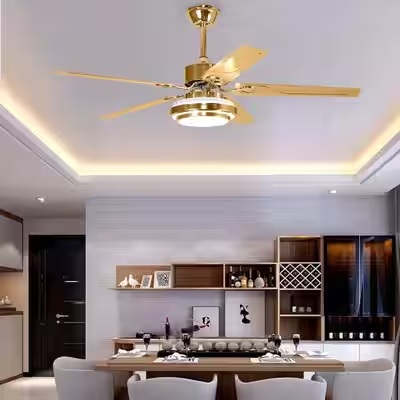
Even without an inverter, if the fan does not stop and runs continuously for about 8 to 10 hours, then how is this possible? You must be thinking that how is this possible without an inverter? In fact, if you have a battery-powered fan installed in your house, then this can be possible. Smart ceiling fans with in-built batteries are now available in the market, with the help of which you can get cool air even without an inverter.
How does this battery fan work?
Generally, fans installed in houses run on AC current and use an induction motor, which consumes more electricity. On the other hand, battery-powered fans use the principle of Brushless Direct Current (BLDC) motor. These fans have a smart charging circuit and a lithium-ion battery pack. These fans work as long as there is electricity and also charge the battery continuously. As soon as the electricity is cut, it automatically switches to battery mode and provides a backup of 8-10 hours.
Why is it better than a normal fan?
While a normal fan consumes 70-80 watts of electricity, this battery fan running on BLDC system consumes only 28-32 watts of electricity. These fans can withstand the voltage range from 120V to 280V without any problem. Normal fans make noise when they run on an inverter, but due to the BLDC system, this fan does not make any noise. Due to the lithium battery used in it and the advanced battery management system (BMS), the battery retains 80 percent of its capacity even after charging more than 500 times. In areas where the voltage is very low or high. Where it is not possible to install an inverter or the power is cut for a very short time. This fan is beneficial for those who want to halve the electricity cost of the fan.
How much does it cost?
These battery fans are expensive compared to ordinary fans. Where a normal fan is available between Rs 1,500 and Rs 2,500, the price of battery-powered BLDC fans ranges between Rs 4,500 and Rs 6,500. However, it gives you full value for your money in terms of battery backup and electricity savings. If there are not many power cuts in your area, then it can also save you from the heavy cost of the inverter.