

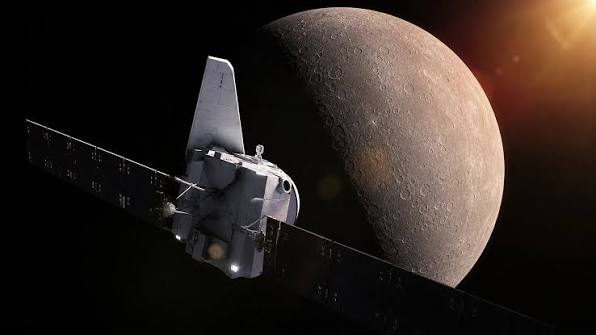
BepiColombo is on a long and thrilling journey. Named after the renowned Italian scientist who developed the ‘gravity assist’ technique—which enables interplanetary travel—this spacecraft was originally scheduled to reach Mercury last year. However, a propulsion issue necessitated a change in its trajectory to allow it to reach the planet using less energy, resulting in a delay of approximately one year in its arrival. After an eight-year journey through space, BepiColombo is now beginning to enter a low orbit around Mercury. On the 3rd of this month, the team managing the mission confirmed the successful separation of the propulsion module from the spacecraft, marking the final phase of the joint mission between the European Space Agency and the Japan Aerospace Exploration Agency. Data received from the spacecraft after a journey of over 200 million kilometers indicates that everything is functioning correctly. Mercury has been explored only twice before, and both missions were conducted by NASA. Even without propulsion issues, reaching Mercury is extremely challenging because it is the planet closest to the Sun; during the journey toward the center of our solar system, the spacecraft essentially falls toward the Sun’s immense gravitational pull, which is far stronger than Earth’s. This is the easy part; the challenge lies in avoiding a continuous, uncontrolled descent. Consequently, reaching Mercury requires an immense amount of fuel—not merely for the journey itself, but to apply the brakes while maneuvering the rocket.
A spacecraft can utilize the gravity of other planets to slow down, but this entails navigating a complex trajectory involving multiple flybys of celestial bodies. To date, BepiColombo has traveled approximately 9.9 billion kilometers. To control its speed, it has completed a total of nine ‘gravity assist’ maneuvers—orbiting Earth four times, Venus twice, and Mercury six times. Due to its proximity to the Sun, the surface of Mercury becomes extremely hot, reaching temperatures of approximately 430 degrees Celsius. As this small planet lacks an atmosphere, the temperature plummets to minus 180 degrees Celsius at night. BepiColombo must withstand these drastic daily temperature fluctuations. Upon reaching Mercury, the spacecraft will separate into two distinct units: the Mercury Planetary Orbiter (MPO) and the Mercury Magnetospheric Orbiter (Mio). The MPO will study Mercury’s surface and internal structure, while Mio will investigate its magnetic field and thin atmosphere. This mission marks the first time multiple spacecraft will orbit Mercury simultaneously, aiming to gather more comprehensive data than ever before.