
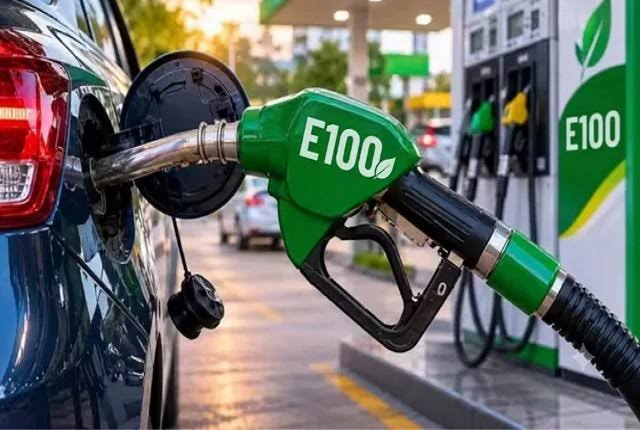
The Ministry of Road Transport has issued a notification regarding amendments to the Central Motor Vehicles Rules. Under these changes, ‘flex-fuel’ vehicles—capable of running on fuel blends up to E100—are now permitted. E100 fuel implies that the vehicle can operate on nearly pure ethanol.
According to media reports, a senior official from the Ministry of Road Transport stated that fuels ranging from E20 (petrol blended with 20% ethanol) to E100 are intended exclusively for vehicles specifically designed and certified for their use. This provision will not apply to other vehicles. Vehicles designed for E20 or standard fuel cannot use E85 or E100 fuel. The Ministry of Road Transport and Highways has introduced certain changes. These include amendments to vehicle classification standards, fuel specifications, and technical parameters related to emission testing protocols.
Furthermore, the government has increased the weight limit for light petrol and diesel vehicles—which fall under the scope of these changes—from 3,000 kg to 3,500 kg. In June of this year, Maruti Suzuki India unveiled India’s first flex-fuel passenger vehicle. The company launched the ‘WagonR Flex Fuel’. It can run on ethanol-petrol blended fuel, ranging from E20 to E100. As part of its strategy, the government is promoting ethanol-blended petrol with the objective of reducing dependence on crude oil imports. Crude oil plays a major role in increasing the country’s Current Account Deficit (CAD). Therefore, by promoting ethanol-blended fuel, the government aims to reduce imports and, consequently, lower the CAD. E20 fuel is already in use in the country; it consists of 20% ethanol and 80% petrol. Flex-fuel vehicles are designed to operate on higher concentrations of ethanol blends. E85 contains 85% ethanol and 15% petrol, while E100 contains approximately 100% ethanol.