

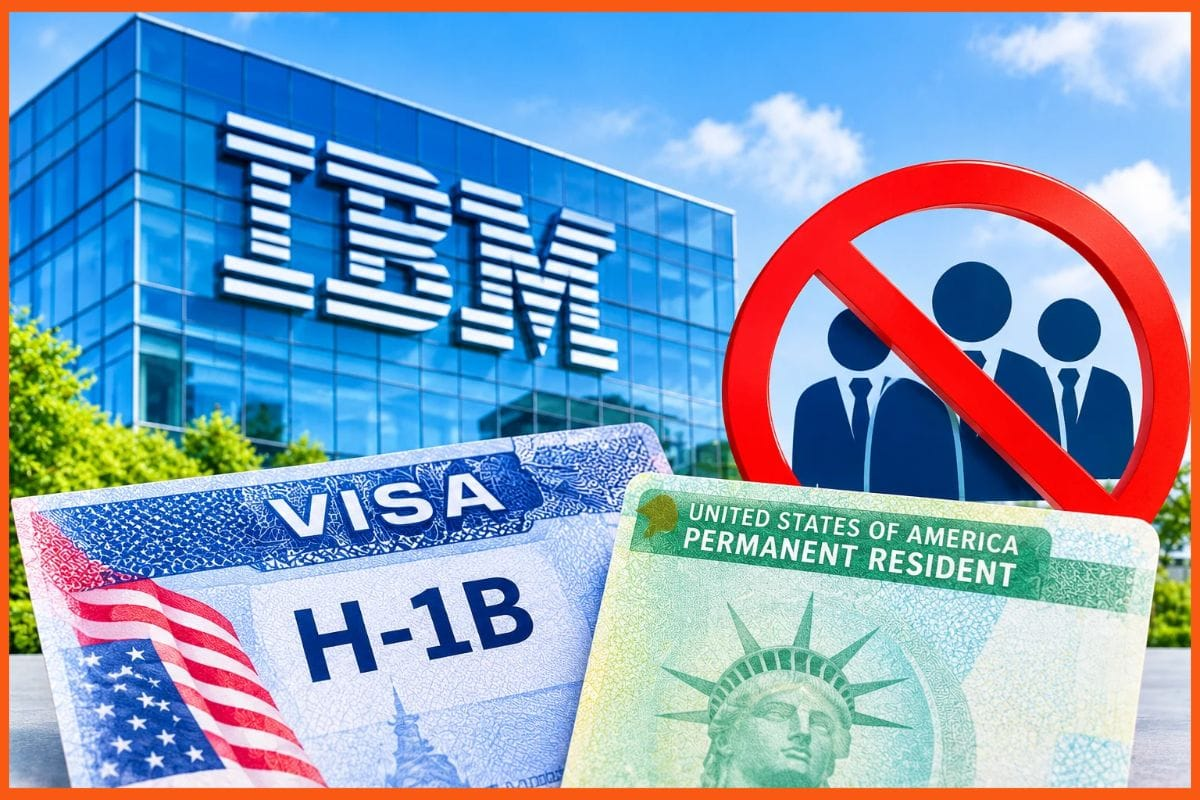
Foreign employees working in the United States are facing increasing difficulties, with uncertainty surrounding their visas. Now, the tech company IBM has added to the concerns of its workforce; it has decided to discontinue work visa and Green Card sponsorship for most positions within its consulting division in the U.S. This division employs over 150,000 people. The decision will directly impact thousands of Indian professionals working in the American tech industry. The company has presented two options to the affected employees: they may either leave the U.S. and continue working for the company from another country, or resign from their positions. Instead of terminating the affected employees immediately, the company has provided a transition period until the end of the year—specifically, December 31, 2026. It is worth noting that when an American company provides a work visa to a foreign employee to work in the U.S., it is referred to as ‘H-1B sponsorship.’
Similarly, when a company applies to grant such an employee the right to reside in the U.S. permanently—known as permanent residency—it is called ‘Green Card sponsorship.’ More than 150,000 employees work for IBM Consulting globally. Although the company has not specified the total number of employees who will be affected by this decision, nor how many of them are based in the United States, it has clarified that this move does not apply to the entire IBM organization; it is limited to roles within IBM Consulting. According to IBM, the needs of the business and its clients have evolved. Previously, the company utilized U.S. visa programs to hire personnel to address a shortage of high-level talent, but the use of these programs has declined over the past few years. Due to the availability of skilled talent and shifting client demands, IBM Consulting has decided to stop sponsoring visas and Green Cards for most of its positions.
IBM’s consulting business has been facing challenges in sustaining growth for some time now. The division’s performance has remained stagnant since 2024. Meanwhile, IBM is transforming itself into a software-focused company. Furthermore, the Trump administration has tightened H-1B visa regulations; these changes include a proposed $100,000 fee for certain new H-1B applications and a prioritization of higher-paying roles. Just last month, companies like Microsoft, Adobe, Cognizant, Infosys, and TCS had to face restrictions under the Permanent Labor Certification Program.