
A border between China and Pakistan does not appear on official maps. However, China’s Xinjiang region shares a border with Pakistan-occupied Gilgit-Baltistan. This entire region formally belongs to India, but Pakistan has illegally occupied it. Consequently, the entire matter is highly complex. Both Pakistan and China claim this as their border. India maintains that the Gilgit-Baltistan region is part of the territory of Jammu and Kashmir and Ladakh that has been under Pakistani occupation since 1947–48. For this reason, any border agreement between China and Pakistan involves territory that India considers its own.
Major Agreement in 1963
China and Pakistan signed a border agreement on March 2, 1963. This agreement demarcated the border between China’s Xinjiang and the Pakistan-occupied northern region. Under this agreement, Pakistan ceded an area of over 5,000 square kilometers from the Shaksgam Valley—or the Trans-Karakoram Tract—to China. On paper, this territory was part of India’s Jammu and Kashmir; Pakistan had first illegally occupied the Indian territory and subsequently transferred it to China. New Delhi has repeatedly stated that Pakistan has no right to transfer that part of Jammu and Kashmir to any third country or to enter into any border agreement regarding it. The Ministry of External Affairs has consistently termed the 1963 China-Pakistan border agreement as illegal. Surprisingly, the 1963 agreement contained a provision stating that the border issue would be renegotiated with the concerned sovereign party following a final resolution of the Kashmir dispute. This implies that even at that time, the agreement was linked to a final settlement of the Kashmir issue.
Why a Border Management Commission now?
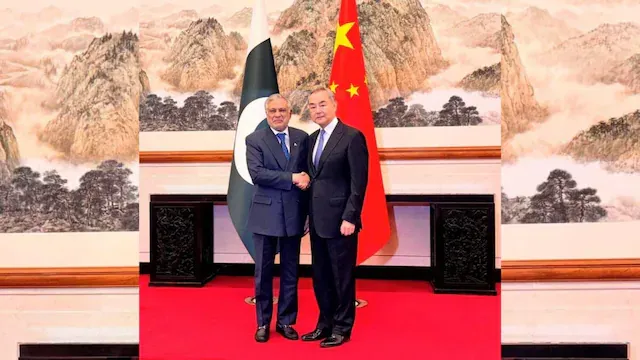
This is where the current dispute arises. Pakistan and China no longer wish to remain confined to the old border demarcation framework. Both nations have activated a joint commission to establish mechanisms for border management, joint surveys, and border-related cooperation. The inaugural meeting of this commission was held in Islamabad. Discussions were held regarding border management, joint border surveys, and cooperation on trade-related issues. This cooperation holds strategic importance for both China and Pakistan. The Karakoram Highway and the China-Pakistan Economic Corridor (CPEC)—connecting the two nations—are also linked to this vast region.
India Rejects the Move
India’s stance is straightforward: if a territory is part of India, neither Pakistan nor China can alter its status regarding its future, boundaries, or administration. In its latest statement, the Ministry of External Affairs reiterated that Jammu & Kashmir and Ladakh are integral parts of India. Consequently, India does not recognize any China-Pakistan border arrangements concerning these regions, as such measures do not impinge upon India’s sovereignty. Therefore, the real issue for India is not why China and Pakistan are managing the border between themselves; the issue is that the border and territory they are discussing constitute Indian land.