
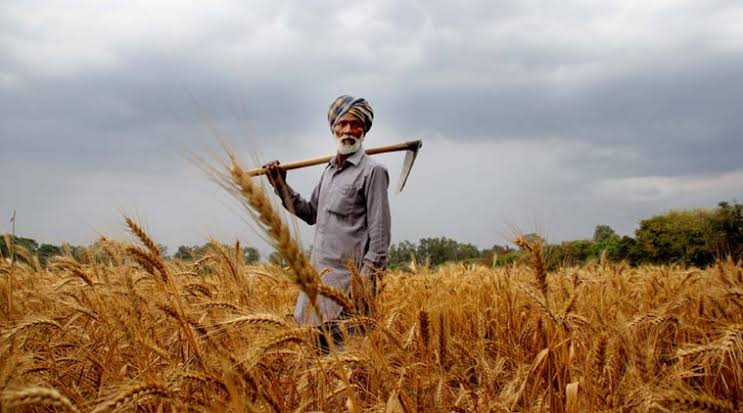
The Central Government has presented a Diwali gift to the farmers. To ensure farmers receive a fair price for their produce, the Union Cabinet has hiked the Minimum Support Price (MSP) for six Rabi crops—including wheat—for the 2027-28 marketing season. The MSP for wheat has been increased by ₹25 per quintal, raising it to ₹2,610; it stood at ₹2,585 in 2026-27. Similarly, the MSP for barley has been raised from ₹2,150 per quintal (in 2026-27) to ₹2,286. The MSP for gram (chana) has increased from ₹5,875 to ₹5,958. The Cabinet has also raised the MSP for lentils (masur) to ₹7,390 per quintal, up from ₹7,000 in 2026-27. The MSP for mustard has been raised to ₹6,613 and for safflower to ₹7,215. In 2026-27, the support prices for both were ₹6,200 and ₹6,540 per quintal, respectively. The government has approved the pricing policy for the 2027-28 Rabi marketing season, under which farmers will receive an estimated ₹90,962 crore. Based on the recommendations of the Commission for Agricultural Costs and Prices (CACP), the Ministry of Agriculture had proposed a modest hike in the MSP. Factors such as production costs, the risk of El Niño, and global and domestic price trends were taken into consideration.
Additionally, the Cabinet has approved several other major proposals. These include a major renewable energy initiative—’PM-DHARA’—and an intelligent traffic management system for Delhi. The total expenditure for these three proposals is estimated at ₹2,79,157 crore. Union Minister Ashwini Vaishnaw provided details regarding these decisions following the Cabinet meeting. He stated that ₹1,86,405 crore has been allocated for the ‘PM-DHARA’ (Developing Harmonised and Accelerated Renewable Energy Access) program. Under this ‘Green Energy Corridor Phase-3’ scheme, an inter-state transmission system will be established to support up to 135 gigawatts of renewable energy across states and Union Territories. The aim is to complete this project by 2032-33. The government has taken this decision with the objective of seamlessly delivering clean electricity—generated from solar and wind energy—to households across the country. Additionally, a 50-gigawatt battery energy storage system will be installed. Under this scheme, electricity will be made available from battery storage during times of need, thereby mitigating issues related to the intermittency of solar energy. The initiative focuses on expanding access to renewable energy and accelerating its development. It is part of the government’s broader efforts to expand clean energy infrastructure. Additionally, the government has sanctioned ₹1,790 crore for an Intelligent Traffic Management System (ITMS) in the National Capital Territory of Delhi. It is expected that this system will utilize technology-driven tools to enhance traffic management and control in the capital.