

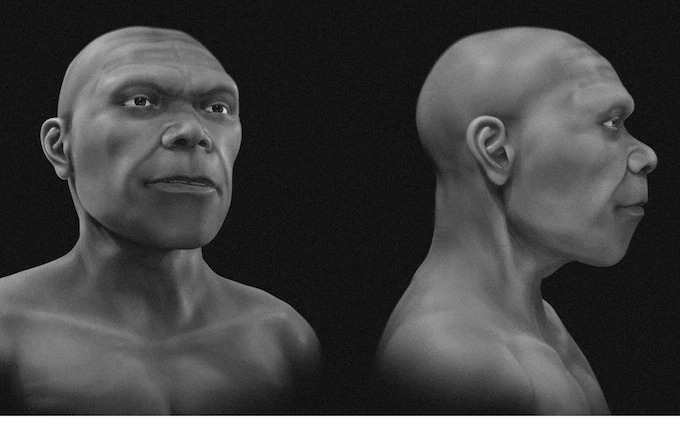
What did the humans who walked the earth approximately 300,000 years ago look like? Scientists have achieved significant success in finding the answer to this question. Using digital technology, a facial reconstruction was created based on the skull of an ancient human. This skull was discovered in the 1960s in the Jebel Irhoud region of Morocco, North Africa. It was found during mining operations in the area, and its significance was revealed through subsequent scientific study. Scientists initially thought it was a Neanderthal:
After the skull was discovered in the 1960s, scientists initially believed it to be the remains of a Neanderthal. Neanderthals are among the closest extinct human species to modern humans; they inhabited Europe and Western Asia approximately 400,000 to 40,000 years ago. However, upon re-analyzing the remains in 2017, scientists realized it was not a Neanderthal. It is one of the oldest known specimens of Homo sapiens. Scientists estimate that this individual lived in North Africa approximately 315,000 years ago. In other words, long before humans migrated extensively out of Africa, the physical structure of Homo sapiens was already remarkably similar to that of modern humans.
How was the 300,000-year-old face reconstructed?
To reconstruct the face associated with the ancient skull, experts utilized a 3D digital reconstruction of the Jebel Irhoud skull, created by the Max Planck Institute for Evolutionary Anthropology in Leipzig, Germany. Subsequently, drawing upon data from diverse African populations, facial muscles and other soft tissues were digitally mapped onto the skull structure. Certain subtle differences compared to modern humans have been observed in this reconstruction; for instance, it is estimated that there were variations such as a relatively broader nose, a more developed jaw, and differences in head shape.
Why is the face depicted with a dark complexion?
Two versions of the face were created for this reconstruction. One is a grayscale version designed to reveal the underlying anatomical structure. The other depicts the individual with dark skin and black hair. However, there is an important point to note here: an ancient skull does not provide direct evidence regarding the individual’s skin, eye, or hair color. Therefore, features such as dark skin, black hair, and a beard have been incorporated into the reconstructed appearance based on existing studies concerning ancient and modern humans.
How similar were they to modern humans?
The study reveals that these Homo sapiens, who lived approximately 315,000 years ago, shared many facial similarities with modern humans. In other words, our ancient ancestors did not look drastically different. The skull discovered at Jebel Irhoud is considered a crucial piece of evidence in understanding the history of human physical evolution.