
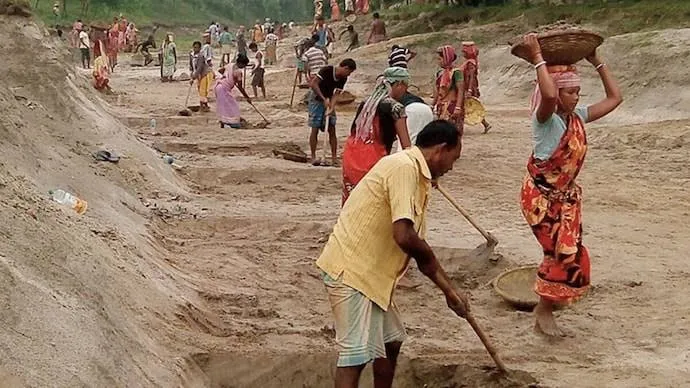
Employment schemes serve as a major source of livelihood for people living in rural areas. Previously, under the Mahatma Gandhi National Rural Employment Guarantee Scheme (MGNREGA), eligible rural households were guaranteed 100 days of work per year. Reports indicate that the Central Government has now implemented a new rural employment act to replace the existing system. Under this new arrangement, eligible households are guaranteed 125 days of employment annually. However, questions have arisen regarding the additional 50 days of employment that were previously available to certain eligible tribal families living in forest areas. It remains unclear whether these families will continue to be eligible for 150 days of work per year following the implementation of the new act. What has changed under the new rural employment law?
According to the information provided, the Central Government has implemented the ‘Viksit Bharat – Employment and Livelihood Mission (Rural) Act, 2025’, effective from July 1, 2026. Under this Act, eligible rural households are guaranteed at least 125 days of employment in a single financial year. Previously, under MGNREGA, this limit was 100 days. With this new provision, it has been increased by 25 days. Consequently, eligible families in rural areas will have the opportunity to secure more days of work.
What benefits were available to tribal families who held forest rights? In January 2014, the Ministry of Rural Development directed States and Union Territories to provide an additional 50 days of wage employment—beyond the 100 days guaranteed under MGNREGA—to certain eligible Scheduled Tribe families who had received land rights under the Forest Rights Act (FRA). However, this benefit was not available to all tribal families; it was restricted to those eligible families who had received land under the Forest Rights Act and did not own any other private land. As a result of this provision, these eligible families gained the opportunity to secure a total of 150 days of employment per year.
Will this additional 50 days of employment be available now? Following the implementation of the new law, the most significant question is whether eligible tribal families—who previously received an additional 50 days of guaranteed employment—will continue to receive this benefit. Under Section 5 of the new law, there is a guarantee of 125 days of employment for eligible rural households. However, it is noted that the new law does not explicitly mention the additional 50 days of employment previously available to forest rights holders. Consequently, a question has arisen as to whether the annual employment guarantee for these families will be capped at 125 days, or if the additional 50-day provision will continue as before.
Why is this issue significant for tribal families? The livelihoods of many families living in forest areas depend on wage labor and forest resources. In such a context, the additional 50 days of employment served as a crucial source of financial support for them. Although the new law increases the employment guarantee from 100 to 125 days, there is a need for clarity regarding the entitlements of families who were previously receiving these additional benefits.