

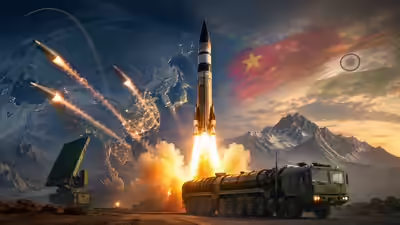
That morning in May 1989 was a very special one. Silence had settled over the Chandipur beach in Odisha, but the Indian scientists sitting in the control room were gasping for breath. 10, 9, 8… The countdown ended with a bang. At that moment, with a loud roar, a 15-meter-high ‘Brahmastra’ shot up into the sky, creating a storm of fire and smoke. As soon as we saw it, this Indian Brahmastra tore the sky apart, expanded far and wide, and disappeared from sight.
In fact, it was the first flight of India’s first ‘Agni Technology Demonstrator’. That day was not just a missile flight from the beach, but India’s first war cry towards a military superpower. India’s success has not only worried the Defense Headquarters in Beijing and Islamabad, but also the Pentagon in Washington. The worry was because India, which was dependent on other countries for small arms until yesterday, had already built its own nuclear ballistic missile ‘Agni’.
Let’s find out how India broke many restrictions and barriers in this journey of the Agni missile, which began 37 years ago, and reached ‘Agni-VI’ from ‘Technology Demonstrator’…
This story begins in 1983, when the then Prime Minister Indira Gandhi gave the responsibility of the country’s missile program to ‘Missile Man’ Dr. A.P.J. Abdul Kalam. The name of this project was Integrated Guided Missile Development Program (IGMDP). At that time, the world had a direct rule – whoever has the power, will rule.
At that time, no country sold advanced missile and space technology for money or gave it as a gift. To stop India, America and the Western countries imposed restrictions called the ‘Missile Technology Control Regime’. Strong efforts were made to ensure that India could never build a long-range missile.
But Dr. Kalam and his scientific team did not give up. They took it as a challenge. When Agni was first tested in 1989, it was not a full-fledged missile; it was a ‘Technology Demonstrator’ (Agni-TD). Its purpose was to check whether India could build a rocket that would not burn up in space and re-enter the Earth’s atmosphere.
It was a two-stage rocket. The first stage had a solid fuel motor from India’s SLV-3 space rocket and the second stage had a liquid engine from the Prithvi missile. When this missile crossed a distance of 1000 km and hit its target, the whole world was shocked. The US and Europe immediately imposed strict technological restrictions on India.
After the 1989 test, almost the whole world closed its doors to India. The supply of hundreds of important components like computer chips, maraging steel, ring laser gyroscopes and carbon composites was stopped. Their aim was to stop the Indian missile program at any cost.
But the scientists of DRDO saw this restriction as a new opportunity. DRDO associated the country’s best universities, IITs and private companies with this program. The maraging steel, which was not available outside, was prepared in Indian laboratories. The carbon fiber that America refused to provide was manufactured in the country’s factories. All the components like navigation system, on-board computer and sensors were made entirely with indigenous technology. This was the beginning of the Agni missile series, which has made India’s defense system completely secure and strong for decades to come.
India’s Agni series: How much power to whom?
Missile – Agni-TD :
Target range – 700 – 1,200 km
Stage / Fuel type – 2-stage (solid + liquid)
Weight – 14 tons
Missile – Agni-1 :
Target range – 700 – 1,200 km
Stage / Fuel type – 1-stage (solid fuel)
Weight – 12 tons
Missile – Agni-2:
Target range – 2,000 – 2,500 km
Stage / Fuel type – 2-stage (solid fuel)
Weight – 16 tons
Missile – Agni-3 :
Target range – 3,500 – 5,000 km
Stage / Fuel type – 2-stage (solid fuel)
Weight – 50 tons
Missile – Agni-4 :
Target range – 3,500 – 4,000 km
Stage / Fuel type – 2-stage (composite / solid)
Weight – 17 tons
Missile – Agni-5 :
Target range – 5,000+ km
Stage / Fuel type – 3-stage (canisterized)
Weight – 50 tons
Missile – Agni-5 (MIRV) :
Target range – 5,000+ km (multiple)
Stage / Fuel type 3-stage + MIRV payload
Weight – 50+ tons
Missile – Agni-Prime :
Target range – 1,000 – 2,000 km
Stage / Fuel type 2-stage (next-gen)
Weight – Super-light composite
Missile – Agni-6:
Target range -8,000 – 12,000 km
Stage / Fuel type 3/4-stage (MIRV/MaRV)
Weight – 65 – 70 tonnes (estimated)