
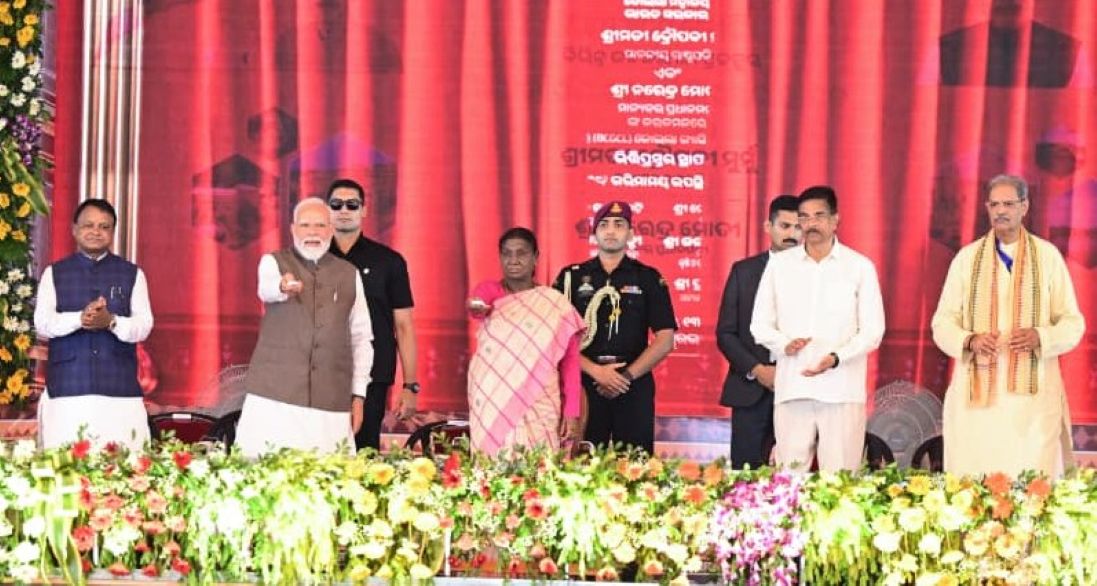
When Prime Minister Narendra Modi and President Droupadi Murmu walked into the Santhali Jaher and Ho Jahera groves of Mayurbhanj together this moment was really special. It was not another important visit to Odisha by big leaders. This visit was actually a deal because it changed how the Indian government thinks about and talks to Adivasi communities.
For a time people have been talking about Adivasi communities in a very limited way. Some people think that these communities only need help from the government. Others think that these communities are about problems like not having enough development being forced to move and security issues. But this way of thinking misses something important: Adivasi communities have been taking care of Indias oldest and most important knowledge for a very long time.
The sacred groves in Pahadpur are a chance to finally fix this mistake.
- These groves are not just places of worship.
- They are old protected forest areas where peoples faith how they take care of the environment, memories and collective identity all come together.
- In these groves nature is not something to be controlled or used for profit. It is something to be respected and taken care of.
- For years Adivasi communities have been living in a way that is good for the environment long before it became popular in global meetings.
- The rituals and festivals like Baha, Sohrai and Mage Parab are closely tied to these trees and soil.
- These groves are where people come together learn from each other and keep their stories and histories alive.
When the important leaders in the country prayed at these sites it was a big deal. It was not a nice gesture. It was actually the official recognition of Santhali and Ho spiritual traditions in Indias history.
President Droupadi Murmu being added a lot of emotion and authenticity to the event. As a daughter of the Santhal community her story is very powerful. She grew up in the villages of Mayurbhanj. Became the President of India. This shows that people from these communities can achieve things. When she stood with the Prime Minister in her home soil it was a moment of national recognition.
This moment also shows that the way the government thinks about these regions is changing. For a time the government only thought about security in these areas.. Peace cannot be achieved just by enforcing laws. It requires listening to people protecting their identities and helping them develop in a way that respects their dignity.
We are seeing an effort to include Adivasi stories in the main story of India.
1. Celebrating Janjatiya Gaurav Divas on Bhagwan Birsa Mundas birth anniversary is one example.
2. They are also building museums to honor the freedom fighters. This is another example of what they’re doing for the freedom fighters. The museums are, for the freedom fighters. This is a way to remember the freedom fighters.
3. The PM JANMAN initiative is also a step in this direction.
Even honoring leaders like Dishom Guru Shri Shibu Soren with the Padma Bhushan shows that the country is starting to recognize the importance of Adivasi struggles.
Some people might think that these moments are just symbolic.. In a big and diverse country like India symbols are very important. They shape how we remember our past. They decide whose stories get told and whose traditions are considered important to the country.
India is not a country. It is a mix of different cultures. Honoring these spaces does not just help one section of society. It makes the idea of India richer. The main takeaway from Mayurbhanj is not, about the speeches or the projects. It is the message that Adivasi heritage is not just a small part of the Indian story. It is the foundation of the story.