

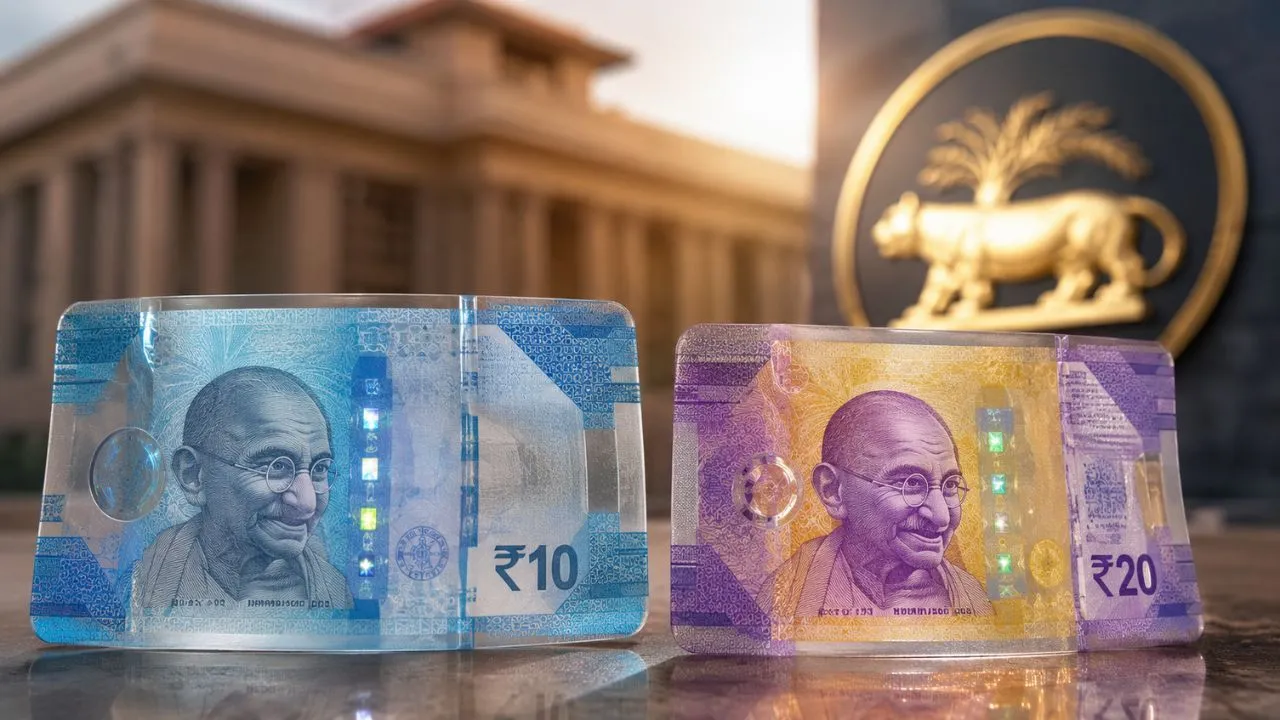
The Reserve Bank of India is going to start a pilot trial of plastic i.e. polymer notes in the country very soon. This has been revealed from a media report. This is part of the RBI’s plan to introduce a new generation of currency in the country. Initially, the RBI will test it on small denomination notes. Official sources have revealed that the first pilot trial may start with Rs 10 and Rs 20 notes. The RBI will take a further decision based on the results and experience of this trial.
If the trial is completely successful, the RBI may start launching these polymer notes on a full scale in the country from 2027. The introduction of polymer notes in the Indian market does not mean that the current paper notes will be discontinued immediately. The RBI has clarified that the new notes will not replace the old paper notes. Both polymer and paper notes will run together in the market. This change will be made in a phased manner. The circulation of paper notes will continue till the new notes are fully introduced. It is worth mentioning that the RBI’s Note Printing Unit has issued a global ‘Expression of Interest (EOI)’. The tender has been invited for the production and supply of a special type of ‘polymer substrate sheet’, which is used to print these notes.
According to the RBI document, global manufacturers have been invited to supply polymer substrates with advanced security features. The last date for submission of bids under this tender has been fixed as August 18. Banknotes made of polymer are more durable than traditional paper notes. These notes are also water and dust proof. Apart from this, they do not tear easily. Due to this, these notes remain in the market for a long time. The biggest advantage of polymer sheets is that they can be easily embedded with advanced security features, making them difficult for counterfeiters to copy.